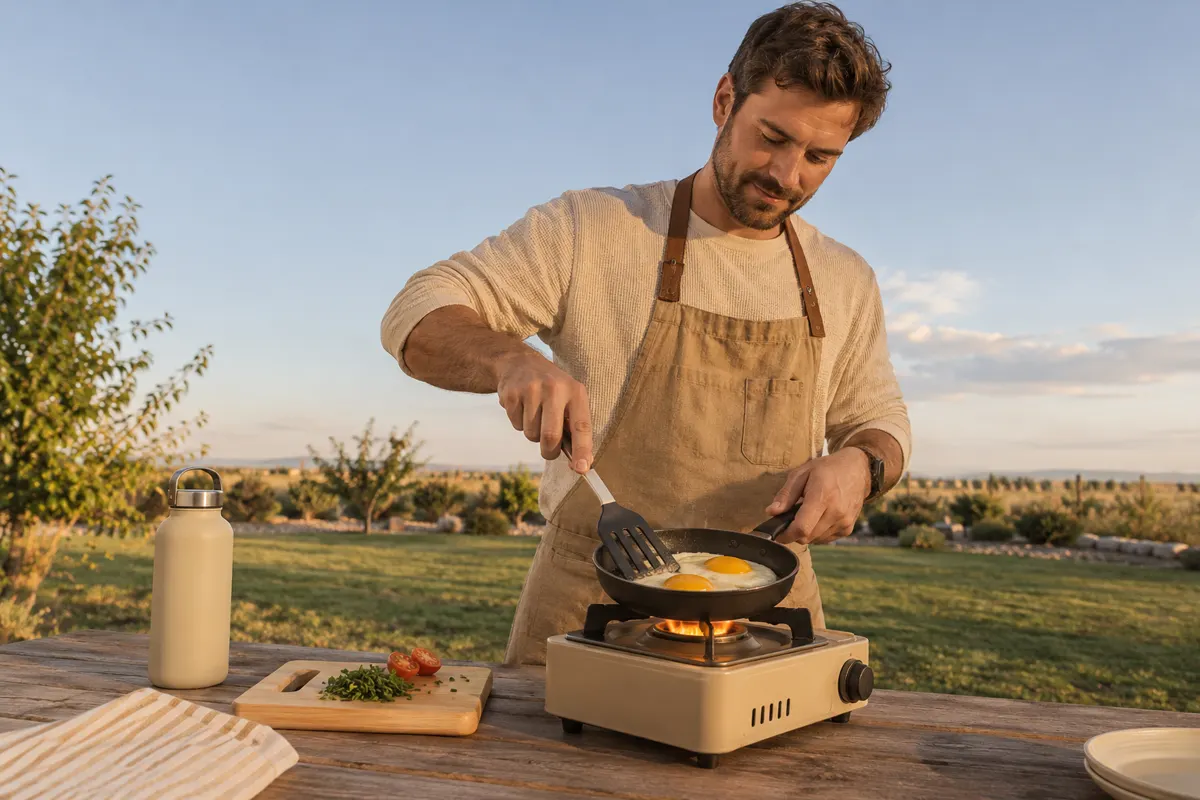
The quick answer
On an apartment balcony, usually no: US model fire codes ban open-flame cooking on balconies of multi-family buildings and within 10 feet of the structure, and many leases ban it outright. Some cities allow small LP-gas devices with a nominal 1-lb cylinder, so the final word belongs to your local fire department and your lease. In a backyard, at a campsite, next to an RV or at a tailgate, a camping stove is normally fine, as long as you cook in open air on a stable surface, away from anything that can burn.
A portable gas stove is designed to go anywhere: the campsite, the lake, the tailgate, the backyard during a power outage. That freedom leads to a common question every fall and winter: “Can I just use it on my balcony?” The answer depends less on the stove and more on where you are standing. Fire codes, leases and park rules treat a balcony, a backyard and a campsite very differently. Below we go place by place, with what the rules say, what changes in practice and a quick safety setup for each.
The rules at a glance, place by place
| Where | Usually allowed? | What decides it | Key precaution |
|---|---|---|---|
| Apartment balcony | Often not | Local fire code, building sprinklers, lease/HOA | Ask the fire department and read your lease first |
| House backyard or patio | Yes, in most areas | Local burn bans, HOA rules | Open air, 10 ft from walls and overhangs |
| Campsite | Yes, even in many fire restrictions | Current fire restriction order for that park or forest | Stable table, cleared ground, never inside the tent |
| Next to an RV or van | Yes, outside the vehicle | Campground rules | Away from awnings, fuel fills and open doors |
| Tailgate or park | Varies by venue | Stadium or park policy, designated areas | Check the venue rules; keep a clear zone |
| Indoors, garage, tent | No | Manufacturer instructions, carbon monoxide risk | Outdoor-only appliance: always cook outside |
1. On an apartment balcony: the strictest place
Balconies are where most people get surprised. Two model fire codes shape the rules in most US cities:
- NFPA 1 (Fire Code) says that in buildings other than one- and two-family homes, grills and similar cooking devices must not be used on a balcony, under an overhang or within 10 feet of the structure. Listed electric cooking appliances are treated separately.
- The International Fire Code, adopted by many cities, bans open-flame cooking devices on combustible balconies and within 10 feet of combustible construction, with exceptions for one- and two-family homes, buildings protected by sprinklers, and LP-gas cooking devices whose container holds no more than 2.5 lb of water (a nominal 1-lb cylinder).
That small-cylinder exception is why you will hear different answers from different cities: some fire departments allow a camping-style stove with a 1-lb cylinder on a balcony; others, and many buildings, do not. On top of the fire code, your lease or HOA can ban all open flames on balconies, and that rule binds you even where the code would allow it. Search your lease for the words “grill,” “cooking” or “open flame.”
What changes in practice: if your city and lease do allow a small-cylinder stove, keep it well away from the railing and walls, never under an upper balcony that overhangs, never near curtains or furniture, and never leave it unattended. If the answer is no, the backyard of a friend, a park with designated cooking areas or the campsite is where your stove belongs.
2. In the backyard: the easiest place at home
For a single-family home, the backyard is where a camping stove is simplest to use, and it is the setup we recommend for weeknight outdoor cooking and power outages. Set the stove on a sturdy, level, non-flammable surface, in open air, away from the house wall, fences, overhanging roofs and dry vegetation. Ten feet of clearance from the structure is a good habit borrowed from the codes above. Our portable gas stove safety tips list the full checklist, and if you are planning for winter storms, how to cook during a power outage shows how a backyard stove fits a home emergency plan.
3. At a campsite: allowed, even during many fire restrictions
Campsites are what camping stoves are built for. A useful detail: when US national forests issue Stage 1 fire restrictions, campfires are often banned, but stoves fueled solely by liquid petroleum or LPG that can be turned on and off are typically still allowed. Stage 2 orders can go further. The rule of thumb is simple: check the current fire restriction order for the forest or park before you go, and cook on a stable table or cleared ground, never inside a tent or vestibule. If you are new to it, our camp stove guide for beginners walks through the first setup.
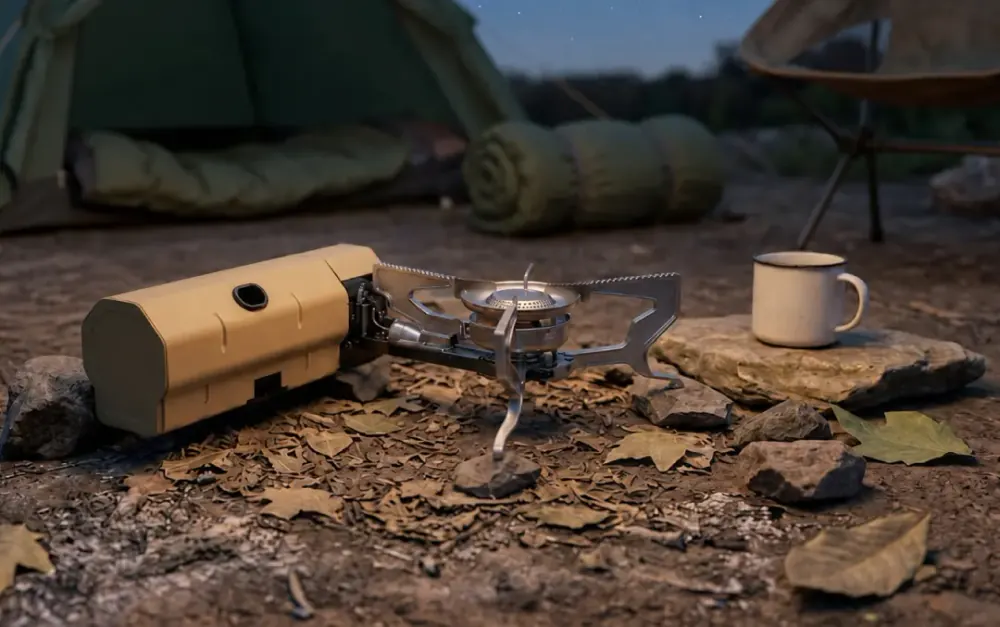
4. Next to an RV or van: outside, never inside
RV and van travelers often cook outside to keep smells and heat out of the vehicle, which is exactly right. A portable gas stove is an outdoor appliance: never use it inside the RV, van, a tent or a garage, where carbon monoxide can build up. Set up a few steps from the vehicle, away from awnings, fuel fill points and open doors, and follow the campground’s cooking rules. Our road trip cooking guide covers what to pack and how to set up at rest areas.
5. At a tailgate or in a park: the venue decides
Stadiums and city parks each set their own rules. Many allow propane and butane stoves in parking lots or designated picnic areas; some limit open flames or cylinder sizes. Check the venue’s tailgating or park policy before game day, keep a clear zone around the stove and never leave it lit while you walk away. Our tailgate cooking checklist has ten easy hot foods for the lot.
One place where the answer is always no: indoors
Whatever the weather, do not move the stove inside the apartment, the garage or the tent. Our detailed guide on whether you can use a portable gas stove indoors explains why carbon monoxide and fire risk make portable gas stoves outdoor-only appliances.
How to choose where to cook: a quick decision list
- Live in a house? Use the backyard or patio, in open air, away from walls.
- Live in an apartment? Read your lease and check your city fire code before you ever light a stove on the balcony. If either says no, cook in a park, at a friend’s yard or at the campsite.
- Heading out camping? Check the current fire restrictions; gas stoves with an on/off valve are usually still allowed.
- On the road? Cook outside the RV or van, away from awnings and fuel fills.
Our recommendation: Qinux GoFlamex
Once you know where you can cook, the stove that makes every one of those places easy is the one we recommend: the Qinux GoFlamex. It folds into its own case and travels in a carry bag, so it moves from the backyard to the campsite to the tailgate in seconds. Its blue flame reaches up to 2600W for a fast boil and turns down precisely for a simmer, it lights with one press, and its smart valves with auto-lock add built-in protection against overpressure, according to the maker. It is the most practical folding gas stove for cooking outdoors wherever the rules allow.
- Up to 2600W with precise flame control — full power for boiling, a low flame for simmering.
- Electronic ignition — one press to light, no matches in the wind.
- Reinforced base — holds a full pot steady on a picnic table or tailgate.
- Smart valves and auto-lock — protection against unexpected overpressure, according to the maker.
- Folds into its own case with a carry bag — ready for the backyard, the campsite or the road.
Owners rate it 4.8/5 on the official site from more than 1,300 reviews, and 94% would recommend it. Right now it costs $119 for one stove (half the regular $238), $210 for two, with free shipping and a 14-day money-back guarantee. It is sold only through the official website. Read our full GoFlamex review or compare the packages on the home page.
Fire codes vary by city and change over time. This article is general information, not legal advice: always check with your local fire department, your lease or HOA and the venue, and follow the stove manual. Use portable gas stoves outdoors only.
Frequently asked questions
Can I use a camping stove on my apartment balcony?
Often no. Model fire codes used across the US ban grills and open-flame cooking devices on balconies of apartment buildings and within 10 feet of the structure. Some cities that follow the International Fire Code allow small LP-gas devices with a nominal 1-lb cylinder, and sprinklered buildings may have different rules. Check your local fire department and your lease before you light anything.
Is a butane stove allowed on a balcony?
It depends on your city and building. The small-cylinder exception in the International Fire Code refers to LP-gas containers with a water capacity of no more than 2.5 lb (about 1 lb of fuel). Many leases and HOAs ban all open flames on balconies regardless of the fuel, and that rule applies to you even when the fire code would allow it.
Can I use a camping stove in my backyard?
Yes, in most single-family homes, as long as you cook outdoors in open air, on a stable, non-flammable surface, away from walls, fences, overhangs and anything that can burn, and follow the stove manual and any local burn restrictions.
Can I use a camping stove during fire restrictions?
Under many Stage 1 fire restrictions on US public lands, stoves fueled only by liquid petroleum or LPG that can be turned on and off are still allowed, while campfires are not. Stage 2 restrictions can be stricter, so always check the current order for the forest or park you are visiting.
Can I cook inside my RV or tent with a camping stove?
No. Portable gas stoves are made for outdoor use. Cooking inside an RV, tent, garage or car can build up carbon monoxide and creates a fire risk. Set up outside on a stable table, away from awnings and the vehicle.
What can I use on a balcony instead?
Where gas is not allowed, some codes permit listed electric cooking appliances on balconies, but rules vary. For outdoor cooking with a gas stove, a backyard, campsite or park with designated cooking areas is the simplest and safest choice.