The quick answer
The best type of camping stove depends on how you travel. A two-burner propane stove is the classic for big car-camping groups; a tiny canister stove wins when every ounce is carried on your back; liquid fuel is for deep cold and remote trips; wood is for people who enjoy tending a fire. For most weekend campers, road-trippers and tailgaters, a compact folding gas stove is the sweet spot: a strong flame, one-press ignition and a case that fits in any trunk. That is the format of the Qinux GoFlamex, the stove we recommend.
Search for a camping stove and you are hit with a wall of formats: green propane bottles, slim butane cans, screw-on canisters, fuel bottles with pumps, little twig-burning cans and stoves that fold into a box. They all boil water. The difference is everything around the boiling: how big they are, how fast they set up, what happens when the wind picks up or the temperature drops, and how much fuss they add to a trip. This guide compares the formats side by side so you can match the stove to the way you actually camp. If you want the buying checklist instead, our guide on how to choose a portable camping stove covers the specs to check.
1. Two-burner propane stove (the classic car-camping box)
The suitcase-style stove with two burners and a green propane cylinder on the side. Popular searches for “propane camping stove” are mostly about this format.
- Strengths: two pans at once, wide cooking surface, propane works in colder weather.
- Trade-offs: bulky and heavy, takes trunk space and a full table, overkill for two people making coffee and eggs.
- Best for: families and groups cooking full meals at a fixed campsite.
2. Single-burner butane tabletop stove
The flat, briefcase-shaped stove you see at buffets and street-food stalls, with a slim butane can loaded from the side.
- Strengths: inexpensive, stable, simple to use.
- Trade-offs: butane loses pressure in the cold, the flat body catches wind, and it is still fairly wide to pack.
- Best for: mild-weather picnics and occasional use.
3. Backpacking canister stove
A tiny burner that screws onto the top of a gas canister. It is the lightest format, built for people carrying everything on their backs.
- Strengths: very light, very small, fast to boil a small pot.
- Trade-offs: tall and narrow, so a wide skillet feels tippy; small pot supports; best at boiling, not frying.
- Best for: hikers and backpackers who mostly boil water.
4. Liquid-fuel stove
A burner connected by a hose to a refillable fuel bottle that you pump to pressurize.
- Strengths: handles deep cold and high altitude well, refillable bottles.
- Trade-offs: priming, pumping and regular maintenance; more ways to make a mess.
- Best for: winter mountaineering and remote expeditions.
5. Wood-burning camping stove
A small metal burner that turns twigs and pine cones into a cooking fire. Interest in wood-burning camping stoves is rising this fall.
- Strengths: no fuel to carry, a campfire feel.
- Trade-offs: needs dry wood, smoke and soot on your pots, slow to control, and often banned during fire restrictions.
- Best for: bushcraft fans with time to tend a fire.
6. Compact folding gas stove
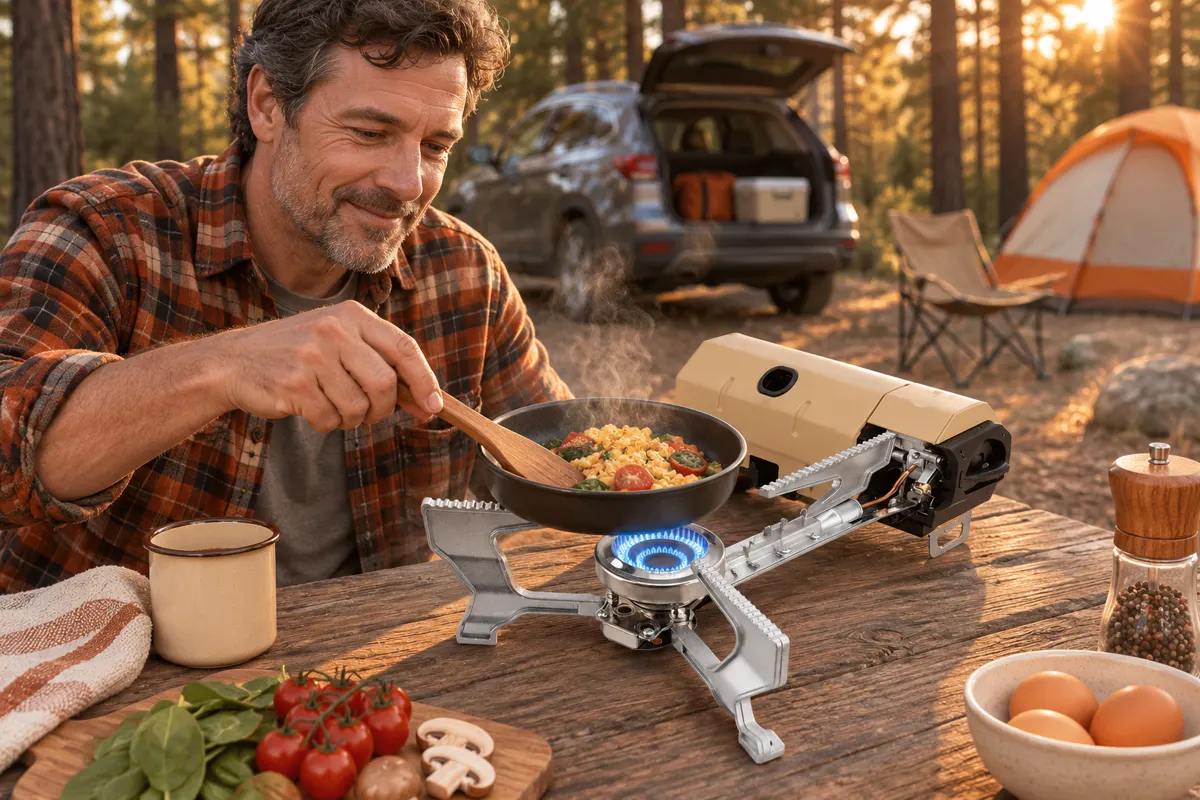
The newest format for car campers: a single strong burner with fold-out pot supports that closes into its own protective case. You get much of the power of a big stove in a package much smaller than a two-burner box.
- Strengths: strong, adjustable flame, push-button ignition, wide fold-out supports for real pans, quick setup and pack-away.
- Trade-offs: one burner, so big group meals take turns.
- Best for: weekend campers, couples and small families, road trips, tailgates, fishing days and a backup for power outages (used outdoors).
The formats side by side
| Format | Size to pack | Setup | Wide pans | Cold weather | Best for |
|---|---|---|---|---|---|
| Two-burner propane | Large | Medium | Excellent | Good | Groups, fixed camps |
| Butane tabletop | Medium, flat | Easy | Good | Weak | Mild-weather picnics |
| Backpacking canister | Tiny | Easy | Limited | Fair | Hikers boiling water |
| Liquid fuel | Small + bottle | Hands-on | Good | Excellent | Winter, expeditions |
| Wood-burning | Small | Slow | Fair | Depends on wood | Bushcraft |
| Folding gas in a case | Compact | Very easy | Good | Follow the manual | Weekends, road trips, couples |
Notice how the folding format sits in the middle of every column: smaller than the classic propane box, more stable for real cooking than a backpacking stove and far simpler than liquid fuel or wood. For people who drive to their campsite, that balance is exactly what matters.
How to pick your format in 30 seconds
- You carry everything on your back for days → backpacking canister stove.
- You camp in deep winter or high mountains → liquid fuel.
- You cook big meals for six at a fixed site → two-burner propane.
- You drive to camp, cook for one to four people and want fast setup → compact folding gas stove.
Whatever you choose, the safety rules are the same: cook outdoors in open air, never in a tent, car or garage, and use only the fuel your manual specifies. Our portable gas stove safety tips cover the rest, and camp stove specs explained decodes watts, BTU and the rest of the box.
Our recommendation: Qinux GoFlamex
If you camp by car, road-trip or tailgate, the compact folding format is the right one, and the Qinux GoFlamex is the stove in that format we recommend. It delivers a strong blue flame of up to 2600W with precise flame control, lights with one press and opens wide supports that hold a real skillet steady. When you are done, it folds into its own case and slides into a carry bag, so it actually comes along on every trip.
- Up to 2600W with precise flame control — a quick boil for coffee, a gentle simmer for eggs and sauces.
- Electronic ignition — one press to light, no matches in the wind.
- Reinforced base — steady under a full pan on a picnic table or tailgate.
- Smart valves and auto-lock — built-in protection against unexpected overpressure, according to the maker.
- Folds into its own case with a carry bag — the space-saving advantage over bulky two-burner boxes.
Owners rate it 4.8/5 on the official site from more than 1,300 reviews, and 94% would recommend it. Right now it costs $119 for one stove (half the regular $238), $210 for two, with free shipping and a 14-day money-back guarantee. It is sold only through the official website.
Want the full picture first? Read our complete GoFlamex review or see the overview on the GoFlamex home page. As with any gas stove, follow the manual, use the fuel it specifies and cook outdoors only.
Frequently asked questions
What are the main types of camping stoves?
The common formats are two-burner propane stoves, single-burner butane tabletop stoves, small backpacking canister stoves, liquid-fuel stoves, wood-burning stoves and compact folding gas stoves that pack into their own case. They differ mostly in size, fuel, how they handle wind and cold, and how much setup they need.
Is propane or butane better for a camping stove?
Propane keeps working at lower temperatures, which is why big two-burner car-camping stoves use it. Butane and butane blends are common in compact stoves and work well in mild weather but lose pressure in the cold. Always use the exact fuel your stove's manual specifies; never swap fuels on your own.
Are wood-burning camping stoves worth it?
They remove the need to carry fuel and are fun on long trips, but they need dry wood, produce smoke and soot, take longer to control and may be banned during fire restrictions. Most car campers and weekenders find a gas stove much more practical.
What camping stove is best for car camping?
For car camping, stability, a strong adjustable flame and fast setup matter more than grams. A big two-burner propane stove suits groups who cook full meals; a compact folding gas stove suits couples and small families who want a strong flame without the bulk.
Can I use any camping stove indoors?
No. Gas, liquid-fuel and wood camping stoves are made for outdoor use. Using them in a tent, car, garage or closed room risks carbon monoxide poisoning and fire. Cook outdoors, in open air, and follow the manual.