The quick answer
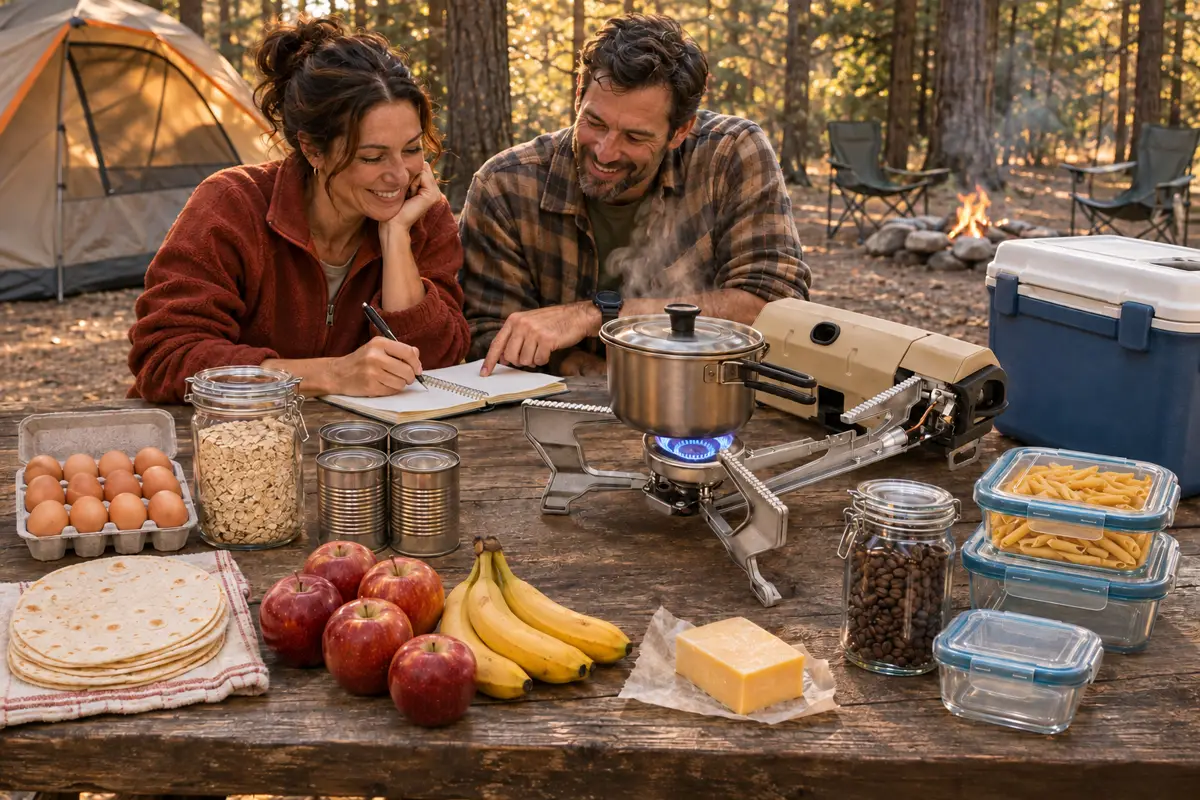
How much food to bring camping = people × days × about 1.5 to 2.5 pounds per person per day, with relaxed car camping at the low end and active or cold trips at the high end. Count your exact meals first, decide how many will be hot, then add a one-meal buffer. Below is the formula, a worked example and a ready-made table for four common trips, plus where a fast, compact stove like the Qinux GoFlamex fits into the plan.
“Food for camping” is one of the most searched camping topics in the U.S., and for good reason: it is the part of the trip most people get wrong in one of two ways. Either the cooler comes home half full of uneaten food, or everyone is hungry by Saturday afternoon and someone drives to the gas station. Both have the same fix: ten minutes with a calculator before you shop. This guide walks you through the math for your own group, step by step.
The formula in four steps
- Count the meals. Meals per person × number of people = total meals.
- Set a calorie target. Calories per person per day × people × days = total calories.
- Convert to food weight. People × days × 1.5 to 2.5 lb = pounds of food to pack.
- Plan water and hot meals. At least 1 gallon per person per day, plus cooking water, and a count of how many meals need the stove.
Step 1: count the meals (not the days)
A “weekend” is not two full days of food. Write down the first meal you will eat at camp and the last one before you leave. A typical Friday-evening to Sunday-afternoon trip looks like this:
| Day | Breakfast | Lunch | Dinner |
|---|---|---|---|
| Friday | at home | at home / on the road | at camp |
| Saturday | at camp | at camp | at camp |
| Sunday | at camp | at camp | at home |
That is 6 meals per person, not 9. For a family of four, 6 × 4 = 24 meals. Add snacks separately: two a day per person is a good default for active days.
Step 2: set a calorie target per person
The Dietary Guidelines for Americans (USDA and HHS) estimate that adults need roughly 1,600 to 2,400 calories a day for women and 2,000 to 3,000 for men, depending on age and activity. Camping usually means more walking, carrying, swimming and cooler nights than a normal workday, so planners use the active end of those ranges. Outdoor schools and retailers suggest about 2,000 to 3,000 calories per adult per day for relaxed car camping and more for long hikes or winter trips. Kids need less than adults; teens on the move can eat like adults.
Step 3: convert calories to pounds of food
Few people shop by calories, so the easiest conversion is weight. The widely used rule from outdoor experts such as REI is about 1.5 to 2.5 pounds of food per person per day. Use the low end (1.5 lb) for a relaxed car-camping weekend with fresh food and a cooler, and the high end (2.5 lb) for hiking days, cold weather or hungry teenagers.
Formula: people × days × pounds per day = total pounds of food.
Step 4: water and hot meals
Water: Ready.gov recommends at least one gallon per person per day for drinking and basic hygiene in an emergency, and it is a sensible floor for a campsite without a tap. Add water for pasta, oatmeal, soup and coffee; pasta alone needs a quart or more per pot.
Hot meals: count which meals need heat. Most groups plan a hot breakfast (eggs, oatmeal, coffee) and a hot dinner, with a cold lunch. Those are the meals that decide how many minutes your stove runs and how much fuel you should pack. Our guide on how to boil water faster while camping shows how to cut that time.
A worked example: family of four, Friday to Sunday
- Meals: 6 meals per person × 4 people = 24 meals, plus 2 snacks per person per full day.
- Calories: two adults at about 2,500 and two kids at about 1,800 = 8,600 calories per full day.
- Weight: 4 people × 2 days × 1.5 lb = about 12 lb of food (relaxed car camping). Add one buffer meal for everyone.
- Water: 4 people × 2 days × 1 gallon = 8 gallons, plus 1 to 2 gallons for cooking and dishes.
- Hot meals: Friday dinner, two breakfasts and Saturday dinner = 4 hot meals on the stove, plus morning coffee.
Ready-made table: four common trips
| Trip | Meals to plan | Food (1.5–2.5 lb/person/day) | Water (1 gal/person/day + cooking) | Hot meals |
|---|---|---|---|---|
| Solo overnight (Sat–Sun) | 3 + snacks | 1.5–2.5 lb | 1 gal + cooking | 2 |
| Couple, weekend (Fri–Sun) | 12 + snacks | 6–10 lb | 4 gal + cooking | 4 |
| Family of 4, weekend | 24 + snacks | 12–20 lb | 8 gal + cooking | 4 |
| 6 friends, long weekend (Fri–Mon) | 54 + snacks | 27–45 lb | 18 gal + cooking | 6 |
Food and water figures count full days at camp; the meal column follows the Friday-evening to last-day-lunch pattern above. Always round up and keep one emergency meal per person (instant oatmeal or a pasta packet) in the bin.
Turning the numbers into a shopping list
Once you know your totals, split them by meal type. Breakfast: eggs, oatmeal, tortillas, coffee. Lunch: wraps, cheese, fruit, nut butter. Dinner: one-pot pasta, chili, stir-fries, foil packets. Snacks: trail mix, granola bars, apples. Our easy camping meals for a portable stove and one-pan camp stove recipes give you menus that fit the hot-meal count, and the camping kitchen checklist covers the gear.
Where the stove fits into the math
The hot-meal count is where your stove matters. Four hot meals and four rounds of coffee for a family is a lot of boiling and simmering, and a weak flame turns every one into a wait. A stove with a strong, adjustable flame shortens each hot meal, keeps the plan on schedule and means you can cook real food (not just snacks) for everyone. That is the job the Qinux GoFlamex was designed for.
Our recommendation: Qinux GoFlamex
Once you have counted your hot meals, the next step is a stove that can cook them quickly and reliably, and that is why we recommend the Qinux GoFlamex. It puts out a strong blue flame of up to 2600W with precise flame control, lights with one press and holds a real skillet or pot steady on its wide supports. For a family planning four hot meals and a morning coffee every day, it is the most practical way to turn your food list into hot food.
- Up to 2600W with precise flame control — a fast boil for pasta and coffee, a gentle simmer for eggs and chili.
- Electronic ignition — one press to light, no matches in the wind.
- Reinforced base — steady under a full pot on a picnic table or tailgate.
- Smart valves and auto-lock — built-in protection against unexpected overpressure, according to the maker.
- Folds into its own case with a carry bag — leaves room in the trunk for the food you just calculated.
Owners rate it 4.8/5 on the official site from more than 1,300 reviews, and 94% would recommend it. Right now it costs $119 for one stove (half the regular $238), $210 for two, with free shipping and a 14-day money-back guarantee. It is sold only through the official website.
Want the details first? Read our complete GoFlamex review or see the overview on the GoFlamex home page. As with any gas stove, follow the manual, use the fuel it specifies and cook outdoors only.
Frequently asked questions
How much food should I bring camping per person per day?
A common planning range is about 1.5 to 2.5 pounds of food per person per day. Relaxed car camping sits at the low end, roughly 2,000 to 3,000 calories per adult, while long hiking days or cold weather push you toward the high end. Multiply by the number of people and days, then add a small buffer.
How do I count meals for a weekend camping trip?
List every meal from the first one you eat at camp to the last one before you drive home. A Friday-evening to Sunday-lunch trip is usually 6 meals per person: Friday dinner, two breakfasts, two lunches and Saturday dinner. Multiply by the number of people to get your total meal count.
How much water do I need for camping?
Ready.gov recommends at least one gallon of water per person per day for drinking and basic hygiene in an emergency, and that is a sensible minimum for a campsite without running water. Add extra for cooking pasta, oatmeal and coffee, and more in hot weather.
How many calories do you burn camping?
It depends on what you do. The USDA Dietary Guidelines estimate that adults need roughly 1,600 to 3,000 calories a day depending on age, sex and activity. Hiking, swimming and cold nights move you toward the active end of that range, which is why campers often feel hungrier than at home.
How many hot meals should I plan on a camp stove?
Most campers plan at least one hot meal a day plus hot drinks in the morning. Count them before you leave, so you pack enough fuel of the type your stove manual specifies, plus a spare.