The quick answer
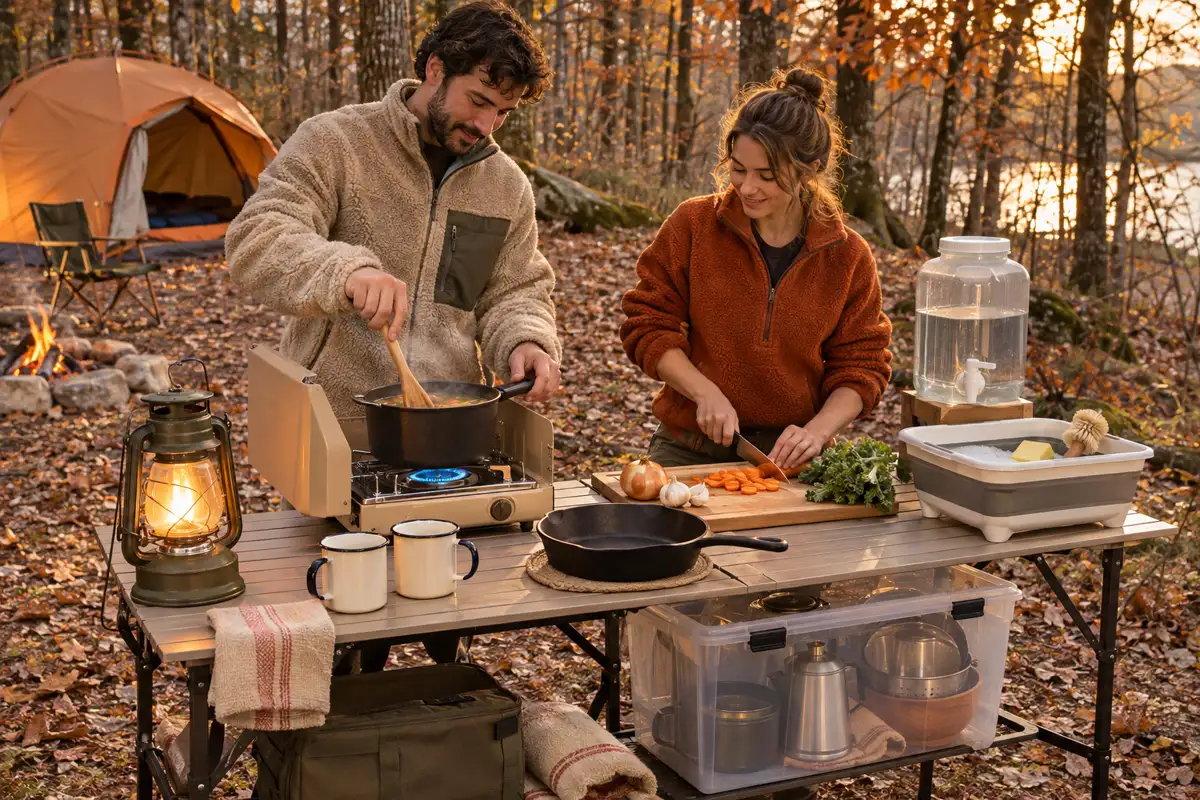
A good camping kitchen setup comes down to six bins of gear: cook, prep, eat, clean, store and stay safe. Pack the non-food gear once in a lidded bin so it is always ready, keep food in a cooler or separate bin, and set up at the site in a line from prep to washing. The item that decides how well everything works is the stove, which is why our list closes with the one we recommend, the folding Qinux GoFlamex.
“Camping kitchen” is one of the most searched camping topics in the U.S., and most of those searches have the same goal: stop forgetting the spatula, stop washing dishes in the cooler lid and start eating real meals outdoors. You do not need a pricey chuck box to get there. You need a short, honest list, bought once and packed so it is ready for every trip. Here it is, organized like aisles in a store and bins in your car.
The camp kitchen shopping list at a glance
| Bin | Must-haves | Nice to have |
|---|---|---|
| 1. Cook | Stove + the fuel it specifies, lighter, pot with lid, frying pan | Kettle or coffee maker, windscreen |
| 2. Prep | Cutting board, chef’s knife, spatula, spoon, tongs | Peeler, can opener, measuring cup |
| 3. Eat | Plates or bowls, mugs, cutlery for everyone | Insulated tumblers, napkins |
| 4. Clean | Wash tub, biodegradable soap, scrubber, quick-dry towel, trash bags | Second tub for rinsing, paper towels |
| 5. Store | Cooler, refillable water jug, food bin with lid | Zip bags, small spice kit, foil |
| 6. Safety and comfort | Headlamp or lantern, first-aid kit, folding table | Pot holders, a small fire extinguisher for the car |
Bin 1: the cooking bin
This is the heart of the kitchen. A stove that is stable, lights reliably and lets you control the flame makes the difference between a quick breakfast and a cold, frustrating morning. Add the fuel your stove’s manual specifies (always carry a spare), a lighter as backup, one pot with a lid for water, pasta and soup, and one frying pan for eggs, pancakes and fish. A lid matters more than people think: it boils water faster and saves fuel.
If you are still choosing a stove, our guide on how to choose a portable camping stove walks through the eight checks that matter.
Bin 2: the prep bin
- Cutting board — a dedicated, easy-to-clean board you only use outdoors.
- A sharp chef’s knife with a sheath — dull knives slip; a sheath keeps fingers safe in the bin.
- Spatula, cooking spoon and tongs — the three tools you will miss most if forgotten.
- Can opener and peeler — small, cheap and easy to forget.
Pro tip from many seasoned campers: prep at home. Chop vegetables, marinate meat and pre-mix pancake batter before you leave, and the camp kitchen becomes a place to cook, not a place to chop.
Bin 3: the eating bin
Plates or deep bowls (bowls handle chili, pasta and cereal), one mug per person, and cutlery. Reusable sets are cheaper over a season than disposables and leave less trash to pack out. Our list of easy camping meals for a portable stove will tell you whether you need anything beyond the basics.
Bin 4: the cleanup bin
This is the bin most first-time campers forget, and the one that makes or breaks the trip. Pack a wash tub (a collapsible one saves space), biodegradable soap, a scrubber, a quick-dry towel and plenty of trash bags. Follow Leave No Trace guidance: wash dishes away from lakes and streams, strain food scraps into the trash and scatter gray water where the campground allows it.
Bin 5: food storage and water
- Cooler: pre-chill it at home, freeze water bottles as ice packs and keep it in the shade.
- Refillable water jug with a spigot: the single biggest upgrade to any camp kitchen. Hands, dishes and coffee all start here.
- Food bin with a lid: keeps dry food away from critters. In bear country, follow park rules on bear-resistant containers or lockers.
Bin 6: safety and comfort
A folding table keeps the stove at a safe, stable working height. A headlamp or lantern matters in November, when it is dark before dinner. A first-aid kit with burn gel belongs in every kitchen, indoors or out. And the golden rule for any gas stove: cook outdoors only, never in a tent, a car or a closed shelter. We explain why in can you use a portable gas stove indoors?
What you can skip
You do not need a full camp kitchen cabinet, a two-burner plus grill plus oven combo, or matching enamel sets to cook well outdoors. Start with the must-haves column above, cook a few trips, and add only what you actually missed. Many experienced campers keep a short note in the bin of things to add or remove after each trip.
How to set up the camp kitchen at the site
- Pick a flat, sheltered spot downwind of the tentsAway from overhanging branches and dry grass.
- Set up the wash station firstTub, soap and water jug at one end of the table, so cleanup happens as you go.
- Lay out the line: prep, cook, eatBoard and knife, then the stove on the stable center of the table, then plates.
- Keep the cooler closed and in the shadeOpen it only when you need something.
- Pack the gear bin before bedClean, dry and closed, ready for breakfast and safe from wildlife.
Our recommendation: Qinux GoFlamex
Every item on this list supports one thing: the stove. The Qinux GoFlamex is the stove we recommend to complete your camping kitchen setup. It folds into its own case, so it lives in the cooking bin between trips, lights with one push and gives you real control over the flame, from a rolling boil to a gentle simmer for eggs.
- Up to 2600W with precise flame control — fast boiling for pasta and coffee, low heat for pancakes.
- Electronic ignition — one press to light, no matches needed.
- Reinforced base — stable on a folding camp table with a full pot.
- Smart valves and auto-lock — built-in protection against unexpected overpressure, according to the maker.
- Folds into its own case with a carry bag — packs as neatly as the rest of your bins.
Owners rate it 4.8/5 on the official site from more than 1,300 reviews, and 94% would recommend it. Right now it costs $119 for one stove (half the regular $238), dropping to $105 each on the 2-pack and $86 per unit on the 5-pack, with free shipping and a 14-day money-back guarantee. It is sold only through the official website.
Want the full picture first? Read our complete GoFlamex review or see the overview on the GoFlamex home page. As with any gas stove, follow the manual, use the fuel it specifies, respect your site rules and cook outdoors only.
Frequently asked questions
What do I need for a basic camping kitchen?
A stove and the fuel it specifies, a lighter, one pot and one pan with a lid, a cutting board and knife, a spatula and spoon, plates, mugs and cutlery, a cooler, a water jug, a wash tub, biodegradable soap, a scrubber, a towel and trash bags. Everything else is comfort.
How do you organize a camp kitchen?
Keep all non-food gear in one or two lidded bins that live packed between trips, food in a separate bin or cooler, and set up the site in a line: prep, cook, eat, wash. Many campers set up the dishwashing station first so cleanup never piles up.
What is the best stove for a camping kitchen?
For car camping, a stable stove with good flame control and quick ignition matters more than the lightest weight. A folding gas stove like the Qinux GoFlamex packs into its own case, lights with one push and offers up to 2600W of output.
How much water should I bring for camp cooking?
It depends on the campsite: many established sites have potable water taps, while others have none. Check your campground’s facilities before you go and bring a refillable jug either way, so drinking, cooking and dishwashing water is always within reach of the kitchen.
Can I leave food in my camp kitchen overnight?
Follow the food-storage rules of your campground, especially in bear country, where many parks require bear-resistant containers or lockers. Never keep food or scented items in your tent.