The quick answer
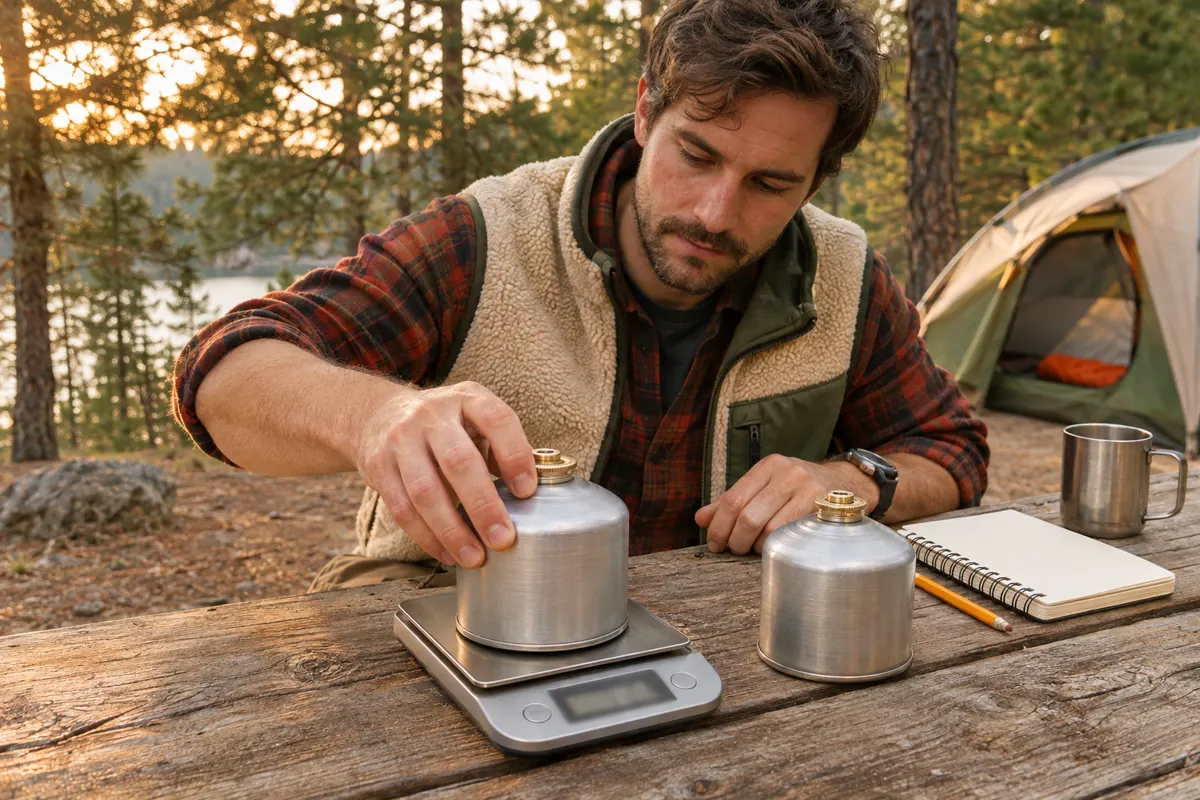
The most accurate way to tell how much fuel is left in a gas canister is to weigh it: current weight minus the weight of an empty canister of the same size equals the fuel left, and dividing by the net weight on the label gives the percentage. At camp without a scale, the float test gives a fair estimate, and a timed test boil tells you how the canister performs today. Shaking only tells you there is “some” left.
Every camper owns at least one mystery canister: half-used on the last trip, dropped back in the bin, and now nobody knows whether it is good for one more weekend or one more coffee. Guessing usually ends one of two ways, either packing three canisters “just in case” or running dry halfway through dinner. Measuring takes less time than worrying about it. Below are the four methods, how to do each one properly, the mistakes that throw the numbers off and how often to check.
Before you measure: what the label tells you
Look at the side of the canister. The net weight (for example 8 oz / 227 g, or 230 g, or 450 g) is the weight of the fuel only, when full. Some brands also print the empty weight or a float gauge. Write the net weight on a piece of tape on the canister if it is hard to read; you will use it every time. Use only the canister or cartridge type your stove’s manual specifies.
Method 1: the scale (most accurate)
- Use a kitchen scale in grams. Grams are more precise than ounces for small amounts.
- Remove the canister from the stove and put the cap back on. Weigh only the canister.
- Find the empty weight. Weigh an empty canister of the same brand and size once and write it down, or use the empty weight printed on the label.
- Do the math. Fuel left = current weight − empty weight. Percentage = fuel left ÷ net weight × 100.
- Write it on the canister. A strip of masking tape with the date and the grams left saves you the next measurement.
| Example (230 g canister) | Value |
|---|---|
| Current weight on the scale | 255 g |
| Empty canister of the same model | 140 g |
| Fuel left | 255 − 140 = 115 g |
| Percentage left | 115 ÷ 230 × 100 = 50% |
The numbers above are only an example; empty weights differ by brand and size, which is why you weigh your own empty one.
Method 2: the float test (no scale needed)
- Fill a pot, sink or calm lake shallows with enough water for the canister to float upright.
- Set the capped canister in the water and let it settle.
- Read the waterline against the gauge printed on the side, if there is one, or against a mark you made earlier when you floated a full and an empty canister of the same model.
- Dry the canister before storing it.
The float test is a good field estimate, roughly to the nearest quarter. It works best in still water, with the canister upright and at about the same temperature as when you made your reference marks.
Method 3: the timed test boil (how it performs today)
Put a fixed amount of water (say 2 cups) in the same pot with a lid, light the stove on the same setting and time it to a boil. Do this once with a full canister so you have a baseline. A clearly longer time on a mild day means low pressure, either because the canister is getting empty or because it is cold. This method measures performance, not grams, which is exactly what you care about on a frosty morning. Our 8 tweaks to boil water faster help you keep the test fair.
Method 4: the shake test (only a yes or no)
Gently shake the closed canister by your ear. A clear slosh means there is still liquid fuel inside; silence means it is close to empty. It cannot tell a quarter from a half, so use it only to sort “some” from “none.”
Common measuring mistakes
| Mistake | What happens | Do this instead |
|---|---|---|
| Weighing with the stove still attached | The number includes the stove | Weigh the canister alone, cap on |
| Using another brand’s empty weight | Off by several grams | Weigh an empty of the same brand and size |
| Reading net weight as total weight | You think it is emptier than it is | Net weight is fuel only |
| Float test in choppy water | The waterline jumps around | Use a pot or sink, still water |
| Test boil on a cold morning vs. a warm baseline | Looks emptier than it is | Compare boils at similar temperatures |
| Trusting the shake test for planning | Running out mid-meal | Weigh before the trip |
How often to check
- Before every trip: weigh every open canister and write the grams on tape.
- After every trip: weigh again and note how many meals and boils you cooked. After two or three trips you will know your own grams per day.
- On longer trips: a float test every evening tells you whether tomorrow’s breakfast is covered.
- At the end of the season: weigh everything before storage so spring starts with an honest inventory. Our end-of-season stove maintenance guide covers storage.
Why the flame weakens before the canister is empty
The fuel inside is liquid; it has to evaporate into gas to reach the burner. Evaporation slows as the canister empties and as it gets cold, so pressure drops and the flame shrinks. That is normal physics, not a faulty stove. Keep the canister out of the wind, sheltered from cold ground, and warmed in a jacket pocket before cooking (never near a flame or heater). If the flame stays weak with a full, warm canister, check our troubleshooting guide for a camp stove that won’t light or has a weak flame.
Where your stove fits in
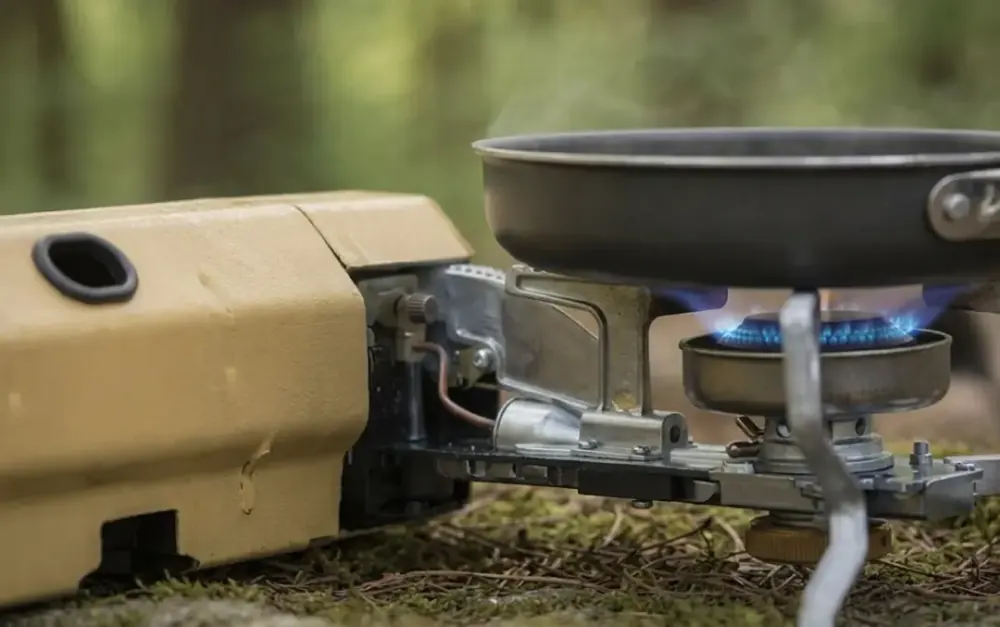
Measuring tells you how much fuel you have; the stove decides how much cooking you get out of it. A stove with fine flame control lets you simmer on a small flame instead of boiling everything on full, and a steady base keeps pots centered over the heat so less of it escapes around the sides. That is the job the Qinux GoFlamex was built for.
Our recommendation: Qinux GoFlamex
Once you know exactly how much fuel you are carrying, you want a stove that makes every gram count, and that is why we recommend the Qinux GoFlamex. Its blue flame reaches up to 2600W when you need a fast boil and turns down precisely for a gentle simmer, it lights with one press, and its smart valves with auto-lock add built-in protection against overpressure, according to the maker. It is the most practical folding gas stove for car camping, tailgates and backyard cooking.
- Up to 2600W with precise flame control — full power for boiling, a low flame for simmering.
- Electronic ignition — one press to light, no matches in the wind.
- Reinforced base — holds a full pot steady over the heat.
- Smart valves and auto-lock — protection against unexpected overpressure, according to the maker.
- Folds into its own case with a carry bag — easy to pack next to your measured canisters.
Owners rate it 4.8/5 on the official site from more than 1,300 reviews, and 94% would recommend it. Right now it costs $119 for one stove (half the regular $238), $210 for two, with free shipping and a 14-day money-back guarantee. It is sold only through the official website.
Want the details first? Read our complete GoFlamex review or see the overview on the GoFlamex home page. As with any gas stove, follow the manual, use the fuel it specifies and cook outdoors only.
Frequently asked questions
What is the most accurate way to check how much fuel is left in a canister?
Weighing it. Put the canister on a kitchen scale, subtract the weight of an empty canister of the same brand and size, and compare the result with the net fuel weight printed on the label. That gives you the grams of fuel left and the percentage.
How does the float test work?
Fill a pot or sink with water and set the canister in it upright. A fuller canister sits lower, an emptier one floats higher. Compare the waterline with a full and an empty canister of the same model, or with the gauge some brands print on the side. It is a rough estimate, but it works at camp without a scale.
Why does my stove get weak before the canister is empty?
Pressure drops as the canister empties and as it gets cold, because the gas evaporates more slowly. On a cold morning a half-full canister can behave like an almost-empty one. Keep the canister out of the wind and warm it in a jacket pocket or sleeping bag before cooking, never with a flame or heater.
How long will a canister last?
It depends on the canister size, the flame setting, the wind and the temperature. The most reliable answer is your own: note the weight before and after each trip, together with how many meals and boils you cooked, and you will know how many grams a typical day uses.
Is it safe to shake or warm a gas canister?
Gently shaking a closed canister to hear the liquid inside is fine. Never puncture it, never heat it with a flame or stove, and store and change cartridges outdoors, away from heat and flames, as the stove manual says.