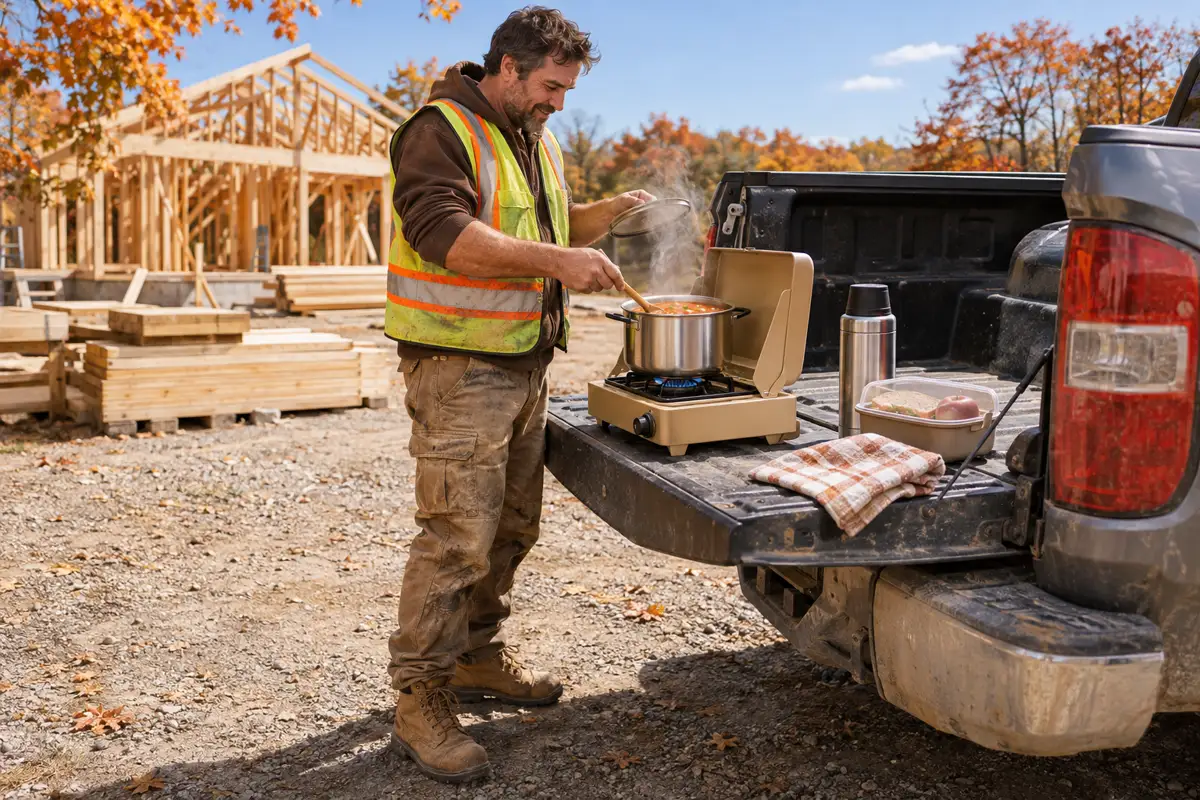
The quick answer
If you work outdoors and have no microwave, a portable gas stove used in the open air is the simplest way to get a real hot lunch. Ask about site rules first, cook only in the break area or another approved spot (never inside the truck cab or a shed), keep a small kit in one box and pick one-pan meals that take 10–15 minutes. A folding stove with push-button ignition like the Qinux GoFlamex fits in a work truck and lights in seconds.
Office workers argue over the break-room microwave. Everyone else — framers, roofers, landscapers, surveyors, farmhands, line crews, delivery drivers and field techs — usually just eats whatever survived the morning in a lunch box. In November, that means a cold sandwich at 34°F with frozen fingers. A hot lunch on a cold workday is not a luxury; it is what gets many people through the afternoon.
This guide is about the workday, 7 to 4 or 9 to 6, wherever your “office” happens to be outdoors. For cooking on the road between destinations, see our separate guide to road trip cooking.
Your hot-lunch options when there is no microwave
| Option | Works best for | Limits |
|---|---|---|
| Thermos filled at home | Soup, chili, oatmeal | Food is only as hot as it was at 6 a.m.; no cooking |
| Electric heated lunch box | Reheating pre-cooked food from a 12V socket or outlet | Slow, warms rather than cooks, needs power or a charged battery |
| Portable gas stove, outdoors | Actually cooking: eggs, quesadillas, noodles, coffee | Open air only; follow site rules on open flames |
| Food truck or diner | Variety, no prep | Cost adds up every day; not near remote sites |
If you can only reheat, a thermos or a heated lunch box is fine. If you want to cook — and on a cold day a fresh fried-egg sandwich beats lukewarm leftovers — a compact gas stove is the tool for the job.
Before you bring a stove to work: four ground rules
- Ask the supervisor or site managerJob sites, farms and utility yards have their own rules on open flames, fuel storage and break areas. Some require permission for any flame. Ask once and you will know exactly where you can cook.
- Outdoors only, alwaysNever inside the truck cab, a van, a site trailer, a shed or a half-closed building. Gas stoves need open air; we explain why in can you use a portable gas stove indoors?
- Pick a safe spotA flat, stable surface away from fuel cans, solvents, sawdust, dry grass and stacked materials, and out of the path of machines and people.
- Store fuel properlyKeep canisters in the toolbox or bed, out of direct sun and away from the cab heater, and follow the stove manual for the fuel it specifies.
The 15-minute lunch break routine
- Minute 0–2: set upDrop the tailgate or open a folding table, set the stove on the flattest part, shield it from wind with the truck body.
- Minute 2–3: light and startPush-button ignition, pan or pot on, medium flame.
- Minute 3–12: cookHeat the soup until steaming, or cook the eggs and tortillas. Stay with the stove the whole time.
- Minute 12–15: off and coolTurn the flame off, let the stove cool while you eat, then pack it away in its case.
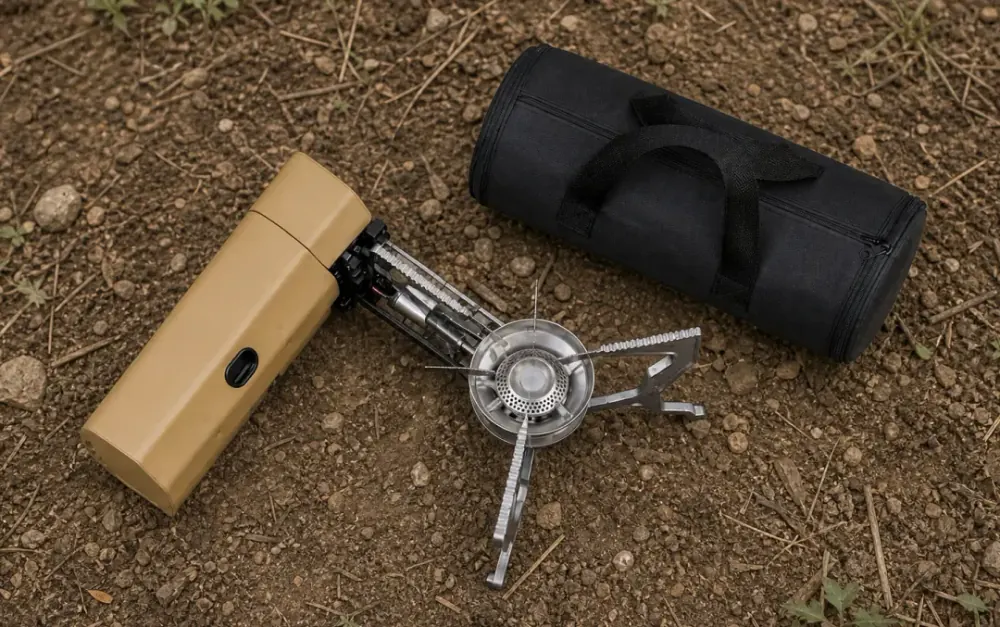
With a folding stove like the GoFlamex, the whole kit lives in its own case behind the seat, so the routine is the same every day and takes almost no space in the truck.
Easy hot lunches that fit a work break
- Soup or chili — made at home, carried cold in a sealed container, heated in a small pot until it steams.
- Quesadillas — tortillas, cheese and leftover chicken or beans, three minutes per side in a pan.
- Fried-egg breakfast sandwich — eggs, a slice of ham, bread or a bagel warmed in the same pan.
- Leftover rice or noodle stir-fry — pre-cut vegetables from a zip bag, one pan, a splash of soy sauce.
- Ramen with an egg — boil water, add noodles and an egg, done in under ten minutes.
- Coffee or cocoa — boil water for the thermos refill; on a freezing day it is half the point. Our guide to making coffee on a camp stove works just as well at a job site.
Food safety still applies at work. Keep perishable food in a cooler with ice packs until you cook it; USDA food-safety guidance is to keep cold food at 40°F or below, and to reheat leftovers until they are hot all the way through.
Your work-truck lunch kit (one box)
- Folding gas stove in its case and the fuel the manual specifies
- One small pot and one non-stick pan
- Spatula, spoon, fork and a small knife
- Insulated cooler with ice packs for the food
- A water bottle for cooking and rinsing, paper towels and a trash bag
- A small fire extinguisher, if your site does not already provide one nearby
Weather on the job: cold, wind and rain
Cold mornings slow gas stoves down, so keep the fuel in the cab (not on the dashboard) until lunch and use a lid on the pot. Wind is the bigger enemy: park so the truck blocks it, or cook in the lee of a wall that is part of the open site, never inside. In rain, cook under an open canopy or tailgate tent with all sides open, or switch to the thermos for the day.
Our recommendation: Qinux GoFlamex
For anyone who works outdoors and wants a real hot lunch, the Qinux GoFlamex is the stove we recommend. It is made exactly for quick cooking anywhere: it folds into its own case, lives behind the seat of a work truck and lights with one push, so a hot lunch takes no more than a normal break.
- Up to 2600W with precise flame control — fast boil for soup and coffee, gentle heat for eggs.
- Electronic ignition — one press to light, even with gloves on, no lighter needed.
- Reinforced base — stable on a tailgate or a folding table.
- Smart valves and auto-lock — built-in protection against unexpected overpressure, according to the maker.
- Folds into its own case with a carry bag — protected in the truck, ready every workday.
Owners rate it 4.8/5 on the official site from more than 1,300 reviews, and 94% would recommend it. Right now it costs $119 for one stove (half the regular $238), dropping to $105 each on the 2-pack and $86 per unit on the 5-pack, with free shipping and a 14-day money-back guarantee. It is sold only through the official website.
Want the full picture first? Read our complete GoFlamex review or see the overview on the GoFlamex home page. As with any gas stove, follow the manual, use the fuel it specifies, respect your site rules and cook outdoors only.
Frequently asked questions
How can I heat my lunch at work without a microwave?
Indoors, the usual options are an electric heated lunch box or a thermos filled with hot food in the morning. If you work outdoors, at a job site, on a farm or from a truck, a portable gas stove used in the open air lets you actually cook: heat soup, fry eggs, warm tortillas or boil water for coffee in a few minutes.
Is it allowed to use a camp stove on a construction site?
It depends on the site. Many job sites have rules about open flames, fuel storage and where breaks can be taken, and some require permission for any open flame. Ask the site supervisor before you bring a stove, and only cook in the break area or another spot they approve, well away from fuel, solvents and building materials.
Can I use a portable gas stove inside my truck or van?
No. Gas stoves need open air. Using one inside a vehicle cab, a trailer, a shed or a tent can build up carbon monoxide and is a fire risk. Cook outdoors on the tailgate, a folding table or the ground, never inside an enclosed space.
What are easy hot lunches to cook on a portable stove at work?
One-pan meals that you prepped at home: soup or chili reheated in a small pot, quesadillas, fried-egg sandwiches, leftover rice or noodles stir-fried with vegetables, and instant oats or ramen with an egg. Keep it to 10–15 minutes of cooking so it fits your break.
How do I keep lunch food safe until break time?
Keep perishable food cold in an insulated cooler with ice packs until you cook it, and heat leftovers until they are steaming hot all the way through. Food-safety guidance from USDA is to keep cold food at 40°F or below.