The quick answer
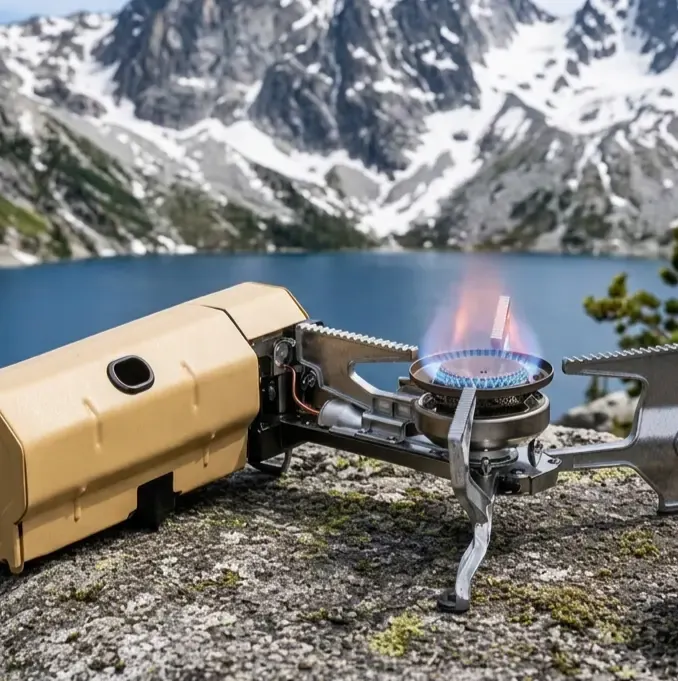
For most of history, cooking outdoors meant an open fire. The modern camping stove really began in 1892, when the Primus soot-free kerosene stove came out of Stockholm. Then came Coleman’s gasoline lamps and stoves in America, spirit burners, and after World War II the gas cartridge, which made stoves light in seconds. Today’s folding gas stoves with electronic ignition and safety valves, like the Qinux GoFlamex, are the latest step in that story.
A camp stove looks like a simple object: a burner, a fuel supply and somewhere to put a pan. But each part of it has a history, and almost every feature you take for granted today, from the blue flame to the push-button lighter, solved a real problem campers struggled with for generations. Here is how outdoor cooking got from the campfire to the folding stove in a carry case, with the tradition separated from what we know today.
Before stoves: the open fire
For thousands of years, the only way to cook away from home was a fire. Travelers, herders, soldiers and later recreational campers cooked over wood or coals with pots hung from tripods or balanced on stones. The campfire has a lot going for it, and it still has a place at the campsite, but it has always had the same weaknesses: it takes time to build, it is smoky, the heat is hard to control, it blackens pots and it depends on dry wood. Many parks now restrict open fires during dry seasons. We compare the two approaches in detail in camp stove vs. campfire cooking.
1892: the Primus and the soot-free flame
The turning point came from Sweden. In Stockholm, Frans Wilhelm Lindqvist developed a small kerosene stove that pressurized its fuel and vaporized it before burning, producing a hot, clean flame without the soot of ordinary wick burners. Sold under the name Primus, Latin for “first,” it launched in 1892 and became one of the most copied designs of its era. Its compact brass body traveled with explorers and mountaineers in the early 20th century and showed for the first time that serious cooking heat could fit in a backpack.
The Primus also set the pattern for the trade-off of liquid fuel: lots of heat and reliability, but you had to pre-heat (prime) the burner and pump the tank. It took practice, and a mistake could mean a flare-up.
Coleman and American car camping
In the United States, the name that defined camp cooking started with light, not heat. William Coffin Coleman began selling gasoline pressure lamps around 1900 in Kingfisher, Oklahoma, and the company later moved into camp stoves. Its liquid-fuel two-burner stoves, with a fold-up lid and windscreens, became the image of the American family campsite through the middle of the century. During World War II the company also produced a compact single-burner stove for soldiers, which helped prove how useful a small portable stove could be in the field.
Spirit burners: simple and silent
Alongside pressure stoves, simpler alcohol (spirit) burners became a classic, especially in Scandinavia. They have no pump and almost no moving parts, which makes them quiet and very reliable. The downside is heat: they are slow to boil water and harder to control, so they appeal mainly to hikers who count every ounce rather than to people cooking a full meal for a group.
After the war: the gas cartridge changes everything
The biggest leap in convenience came with sealed gas cartridges and canisters in the decades after World War II, with European brands among the pioneers. Instead of pouring fuel, priming and pumping, you connected a small pressurized container and turned a knob. No spills, no smell on your hands, and the flame could be turned down to a simmer.
In Japan and Korea, slim cassette-style stoves running on butane canisters became a fixture of everyday life, used at the dinner table for hot pot and grilling as much as outdoors. Their low, flat shape is one of the clear ancestors of today’s compact tabletop camp stoves.
The modern era: ignition, control and safety
The last few decades refined the stove rather than reinventing it. Piezo and electronic ignition replaced matches. Better burner heads produced a steadier blue flame, which signals clean, efficient combustion. Wider, reinforced bases made stoves stable with real cookware. And safety features such as overpressure protection and locking connections became selling points. Power ratings also changed how stoves are compared; if the numbers on the box confuse you, see camp stove specs explained: watts vs. BTU.
Then and now
| Era | How it worked | What it solved | What it still lacked |
|---|---|---|---|
| Open fire | Wood or coals | Heat anywhere there was fuel | Control, speed, no smoke, fire rules |
| Primus (1892) | Pressurized, vaporized kerosene | Soot-free, portable, powerful heat | Priming and pumping, practice |
| Coleman liquid fuel | Pumped gasoline, two burners | Family-size cooking at the campsite | Bulk, priming, fuel handling |
| Spirit burner | Burning alcohol, no pump | Silent, simple, light | Low heat, slow boil |
| Gas cartridge | Sealed pressurized gas | Instant start, clean, adjustable | Older designs were bulky or flimsy |
| Folding gas stove (today) | Gas, electronic ignition, safety valves | One-press start, kitchen-level heat, packs into its own case | — |
What tradition got right, and what we know today
The old campers were right about the essentials: a stable base, a sheltered flame and steady heat make better food than a roaring fire. What has changed is that you no longer need skill to get there. A modern stove gives the controlled heat that once required a well-tended bed of coals or a carefully primed burner, and it does it with the turn of a knob. The safety lesson has not changed at all: gas stoves belong outdoors, as we explain in can you use a portable gas stove indoors?
Our recommendation: Qinux GoFlamex
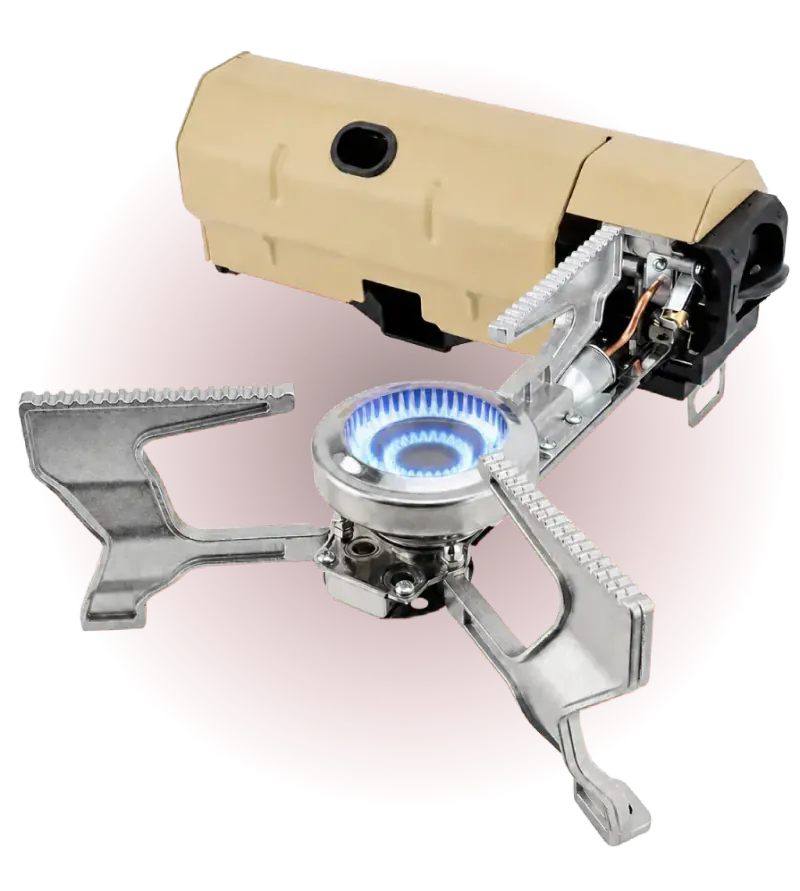
If you want the modern end of this 130-year story, the Qinux GoFlamex is the stove we recommend. It packs everything campers spent a century asking for into one folding unit: the clean blue flame the Primus made famous, the family-size cooking power of the classic car-camping stove, and the instant start of gas, with safety features the old designs never had. It is the most practical way to cook a real meal outdoors without priming, pumping or fiddling with matches.
- Up to 2600W — real kitchen-level heat for boiling, searing and one-pan meals.
- Electronic ignition — one press to light, no matches needed.
- Precise flame control — a steady blue flame from simmer to full power.
- Reinforced base — stable with real pots and pans.
- Smart valves and auto-lock — built-in protection against unexpected overpressure, according to the maker.
- Folds into its own case — with a carry bag, it goes from car trunk to flame in seconds.
Owners rate it 4.8/5 on the official site from more than 1,300 reviews, and 94% would recommend it. Right now it costs $119 for one stove (half the regular $238), dropping to $86 per unit on the 5-pack, with free shipping and a 14-day money-back guarantee. It is sold only on the official website.
Want the full picture first? Read our complete GoFlamex review, see the quick overview on our home page, or start cooking with our easy camping meals for a portable stove. As with any gas stove, follow the manual, use the fuel it specifies and cook outdoors only.
Frequently asked questions
Who invented the camping stove?
There is no single inventor of every camping stove, but the first widely successful portable pressure stove was the Primus, a soot-free kerosene stove developed in Stockholm, Sweden, and launched in 1892. It became the model that many later portable stoves followed.
When did Coleman start making camp stoves?
Coleman began with gasoline pressure lamps around 1900 in Kingfisher, Oklahoma, before moving into camp stoves. Its liquid-fuel two-burner stoves became a classic of American car camping, and the company also supplied compact stoves to US troops during World War II.
What did people use before camping stoves?
Open fires. Travelers, soldiers and campers cooked over wood fires or coals, using pots hung from tripods or set on stones. It works, but it is slow, smoky, hard to control and often restricted today because of wildfire risk.
Why did gas stoves replace liquid-fuel stoves for most campers?
Convenience. Liquid-fuel stoves usually need priming, pumping and some practice. Gas stoves that run on sealed cartridges or canisters connect in seconds, light instantly and turn down easily, which is why most car campers, tailgaters and picnickers now use them.
Is a modern portable gas stove safe?
Used outdoors and according to the manual, yes. Modern designs add features older stoves never had, such as electronic ignition, precise flame control, stable bases and, in the case of the Qinux GoFlamex, smart valves against overpressure and an auto-lock, according to the maker.